
On three ghosts

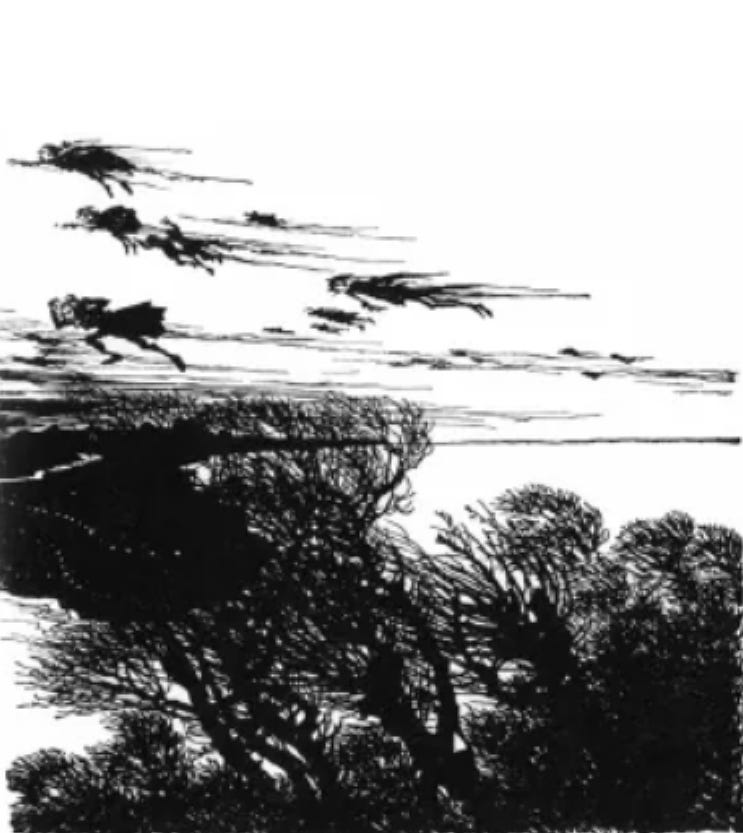
I hear the clanking of chains before I see him, hovering at my window in his Victorian nightgown, his blueish face framed by white hair and moonlight. He doesn’t look real enough to frighten me, but I sit up in bed to get a clearer look. It’s his voice that startles me, low and reverberating, rattling the glass of water at my bedside, “I am the ghost of Autism’s past.” I know I must be dreaming, but now I am afraid.
My fingernails dig into the mattress, resisting the invisible pull that has me sliding to the foot of the bed. “But I’ve read about autism’s past already. Those early journal papers, case studies of autistic boys. The 1940s, institutions, eugenics. Children like mine, routinely condemned with the swish of a pen…” I hesitate as my mind conjures a mother. She has gathered herself despite her uncertainty - neatly dressed, hands folded, politely deferential to the man with the white coat, the official documents, the false assurances. I daren’t look at her. Can’t bring myself to picture her face, her eyes. Please no, don’t make me look there.
The ghost sighs, impatient with me, “That is not how this works. You’ve read Dickens? Or at least watched the Muppets version? I can show you only that which falls within your lifetime. You see these chains that bind me? Their weight is that of your past, confining me as much as you. We cannot travel beyond that.”
I close my eyes and feel movement, tumbling, through air as thick as water. Then a pause. A tentative stillness. Echoes of half-suppressed coughs, the shuffling of feet and paper. When I look, the ghost and I are standing at the back of a lecture theatre. The girl at the desk beside us seems oblivious to our presence. She has pink hair, too much eyeliner and my face. Her chin rests wearily on her fist. Probably hungover. The presentation overhead shows a triangle - The triad of impairments - Social communication, social interaction, imagination.
“Do you remember what you were thinking?” asks the ghost. I look at my former self and I know immediately. She’s wondering how it might feel to have no imagination. Her father and those questions he saved for long car journeys, “Can you stop thinking for a whole minute? Try it. Ha! You’re thinking about not thinking, aren’t you?” It’s a little like that. She’s imagining not imagining. Stripping her thoughts of colour and texture, flattening them out. Trying to perceive the world simply, literally, without embellishment. She is finding this impossible. Who would she be without imagination? Would she still be human? “Dehumanising thoughts,” whispers the ghost. “And where does that lead?”
The world shifts, pivots on itself, the way it does in dreams, and the ghost and I are following my former self into a house. She’s slightly older now, trying to figure out how to be an adult, a graduate, maybe even a professional, a prospect that still terrifies her. She carries herself awkwardly, smiles uneasily, but she’s trying. The pink hair is gone now, the hangovers less frequent. I remember this house well. One of the largest in the area. We walk in through the backdoor, like the nanny and the housekeeper, no-one ever knocks. We soon find him in the playroom. He was always a beautiful child, huge dark eyes, looks about four years old here. He’s sitting with his mother, lining up his Thomas trains diagonally across the rug. There’s a serenity to his focus, tilting his head and examining each train with his peripheral vision, adjusting its position before continuing. His mother looks embarrassed to have been caught helping him, passing him trains from the box, colluding with the lining up. She would never have let me do that.
“It’s okay to play the way he wants to play. Don’t worry.”
“She has no consciousness of you,” the ghost reminds me, “You are not of this time.”
I watch my former self, silent in the doorway, fearful of intruding further on this moment between mother and son. She’s ruined it already. She knows that. She’s unsure of what to say.
They were advertising for Psychology students. 40 hours a week is a lot to cover. They needed a team. I had never heard of ABA therapy, but I was interested in autism, I enjoyed working with children. Just a few hours a week, they said. Training provided. It wasn’t too intense at first. Showing the kid how to wave, how to clap, then celebrating exuberantly with toys and praise. As time went on, I became less comfortable. The tasks we were told to take him through were getting ever longer, broken down into many steps before he could earn his reward. Hours at a table, all self-chosen activity redirected back again. I would think of the children I’d babysat for as a teenager, letting them boss me around, dress me up, cover me in paint and glitter, make me run around the house with them on my back. That had been a lot more fun. Why did this have to be so different?
“You knew this felt wrong,” the ghost hisses in my ear, “You should have left sooner.”
The trains are all laid out now, a perfect line of symmetry through the centre of the rug. A journey of changing features, one train flowing to the next as naturally as footsteps. The boy is still studying each one in turn, enthralled by their detail, by all he associates with them, all they make him feel. The researchers were wrong. He is imagining. Does imagination only count when it’s externalised? Showcased for others as art or narrative, projected onto toys and acted out? Does it have no value before then? A person’s inner world, the essence of their humanity, does that need to be proven before it’s respected? Before it’s even believed in?
His mother cradles a train in her palm, flicking the wheels with her thumb, watching them spin. She doesn’t want these people traipsing through her house all week. Today she wishes only to sit beside her child and help him sort his toys. It’s her fear that pulls her away from these instincts. What options does she have? She wants him to fit the world because she knows the world won’t change for him. The ground will never rise for him. The air won’t hold him up. He will only fall,
and fall
and fall…
The thought of falling hits my muscles all at once and they contract, jerking me awake, returning me to my bed, alone now.
The following night I await the ghost of autism’s present. The present must be better, surely? I’m thankful to be raising my own autistic child in the age of neurodiversity. We now live in a world with ‘autism friendly’ cinema showings, quiet hours in shopping centres, sensory rooms in airports. Autistic people are starting to be listened to, thanks to social media. Public understanding is increasing, accommodations are being made.
The ghost appears without warning or fanfare, easy to miss if I hadn’t been looking. They sit in a low squat on my windowsill, looking towards me but not quite at me. Their figure is slight with soft curves and boyish features. Short hair - a fading purple dye just visible at the tips, a crumpled T-shirt displaying a slogan in bright yellow lettering, something about beautiful brains. They look so comfortable that it takes me a minute to notice their ankles, bound with the same chains as the ghost that came before. I walk over voluntarily, curious now, reaching out to touch them, wondering if my hand will go straight through, like the ghosts in cartoons. They flinch and jump backwards from the window, dragging me out along with them. I look down and I realise - I’m tangled in those chains.
The air outside feels cool, the breeze strong. I wait for the ground to solidify beneath me, for my vision to clear so I can see where I am… We are watching a version of myself again. Not young this time, more like my current self… But not quite. She is standing on a cliff, watching the way the sea hurls itself violently, pointlessly, repeatedly at rocks. I remember this. Of course I do. “This isn’t the present,” I tell the ghost, “This was four years ago.”
“I am the ghost of the present paradigm,” they explain, “my reach extends beyond mere moments.”
Mere moments. This one was a low point. We had just come out of another covid lockdown. My autistic five-year-old had lasted in mainstream school for three months before they said he couldn’t stay. He was now at home with no school, no groups to attend, nothing to do, everything closed. He had stopped speaking beyond the occasional single word. I didn’t feel I was being much help to him. I was struggling to get through a day, even an hour, without crying. My husband had suggested I go out. I had nowhere to go, so I just kept driving. Two hours to the coast. The highest cliff I could find. I wasn’t thinking of jumping. Only needing to remind myself that I still wanted to live. To feel that instinctive pull away from the edge, to experience my aliveness as an active choice, not just a default state.
The problem of the neurodiversity paradigm is not its ideals but its failure to deliver what it promises within our current structures. Too many autistic people and their families remain isolated and unsupported. And most are now exhausted too, bashing their heads against walls which sometimes crack a little, sometimes bend, but never actually seem to break.
All those meetings, all that paperwork. He doesn’t even understand that. Can’t even do this. Even when staff try hard, he still can’t… Yes, we’re sorry, we have to phrase this negatively, it’s the only way to meet thresholds, to get funding, we know you understand. Maybe we can refer you here, maybe there, long waiting list but still, maybe. Write another report, another assessment, find him a special place, staffed by special people who know special things – things we don’t, presumably. Not that we don’t want him, bless him, but… no, no resources here, targets to meet, other children to think of, you know how it is.
The neurodiversity movement presses loud against my ears, holding me to account, pushing insistently at the limits of the possible. Surely, we can stretch those boundaries of central tendency to include more people. It’s okay to be different. Your child has the right to access the classroom along with everyone else. You just need to fight harder!
Schools seem happy to change their image, to brand themselves inclusive, to make wall displays about diversity, to decorate them with rainbows. Happy to make minor adjustments to what they already do, a visual timetable on the wall, that one kid at the back with the ear defenders and the fidget toy. Reasonable adjustments can make a difference, but they can’t be all we’re fighting for. Systems built around an average still create outliers by design. It will stay like this until we question why children need to be sorted, measured, and funnelled through childhood in this way at all. Forced to spend all day at desks, under artificial lights, working through standardised curriculum, preparing for standardised tests. Relentlessly compared and ranked against each other, preparing for an economy that only does the same. Many cling to the edges for years, only to discover they are the low scorers, the opposite end of the distribution, the necessary failures that make the high scores worth something. And what about my child? I can’t even get him in the building. No room for him on the scale at all. He falls right off the end.
Falls,
and falls
and falls.
She doesn’t want to fall. We watch her stepping away from the edge, following the narrow footpath down, heading for the beach.
“Your despair didn’t help,” says the ghost. “It weighed you down and affected those around you. You think you’re fighting against the world, but you need to fight yourself first. You know that don’t you? It’s why you’re here.”
We watch the former me as she reaches the sand and pulls off her shoes. She’s brought no towel with her, no swimsuit. She doesn’t care. There’s no one around. She strips to her underwear and runs into the waves. It’s September, the tail end of summer, but the sea is always cold in England. As the water reaches her chest, the shock grips her, making her gasp, like the first breath of life.
I peer at the bedroom walls, alert for movement, suspicious of shadows. “Ghost of the future?” I call out, “Are you here? With all your grim warnings to throw at me? Go on then. May as well get it over with. There’s nothing you can show me that I don’t already fear. Bring it on. I’m sure I deserve it. To atone for all I’ve done, for all I wanted to do and couldn’t. Not my baby though. He deserves none of this. You think you can tell me his future? I dare you to try. Too many people have tried that already. I refuse to believe a word of it.”
A mist descends on the windowsill. As it clears, I see this ghost is small, a little bird, no chains, just feathers. Feathers dropping like leaves across every surface, as she flaps around the room. Occasionally she lands back on the windowsill, hops in circles a few times, then launches herself up again. As she flies, she sings. Sings for all that’s not yet happened, all that might still be. Sings the tune without the words and never stops at all. She darts through the open window and hovers outside, still singing, compelling me to follow her. Can I follow? Would the ground rise to meet me? Would the air hold me up?
At that moment, the boundaries between inside and outside vanish, along with the ceiling. The sky sprawls itself open above us, stretching itself out to a far-flung horizon, to distant hills, a dawning sun. Our feet find themselves in a forest. The bird is beside me, perched on a low branch, quiet now, head tucked inside one wing, preening her feathers. The sounds of children echo around us. To my left, a small boy stands at a mud kitchen, filling a baking tray with fistfuls of moss. To my right, a hammock holds two little girls, hair and limbs tangling together as they fall into each other, trying not to topple out. In the centre, a canopy, strung up with bunting, and beneath that a campfire. There he is, my boy, older and taller than I’ve seen him, moving with confidence, more comfortable in his body. He pushes a marshmallow on to a stick and hands it to a friend. He is known and loved and free here – the way he needs to be. Beyond the campfire, there is something for everyone. Blanketed dens with cushions and fairy lights, a workshop, an art studio, a puppet theatre, a library, storytellers with bags of sensory props, dancers draped in coloured ribbons. Further down the hill, an apple orchard, fields with grazing animals, raised beds full of vegetables, blackberries in the hedgerows. Strong coffee for the parents, who can stay all day if they want to. Everyone is welcome here, regardless of neurotype. There is no average, no normal, no standard path. The interests and needs of every child are honoured here, included, designed around.
Is it naïve of me to want this? The world can feel so cruel, so broken. How did we become so stuck? Because we couldn’t imagine a different future? But who would we be without imagination? Would we still be human?
My sensory seeking boy finds a patch of wild garlic, he gathers it up, pressing it against his nose. A few leaves for his mouth and some in his pockets for later. He lifts his head, eyes tracking the bird as she flits between the trees ahead. He follows her to an oak tree, swinging himself into the branches with ease. He always had a talent for that. He climbs as high as he wants to, nobody saying he can’t. Ghosts watch him from above, faint shadows in the flickering leaf-light. The chains at their feet merge into the mist - fading, drifting, then dissipating, as the air is warmed by the rising day.